
Resolven & District Amateur Operatic Society – A New Decade
Part 4
1960 – 1966

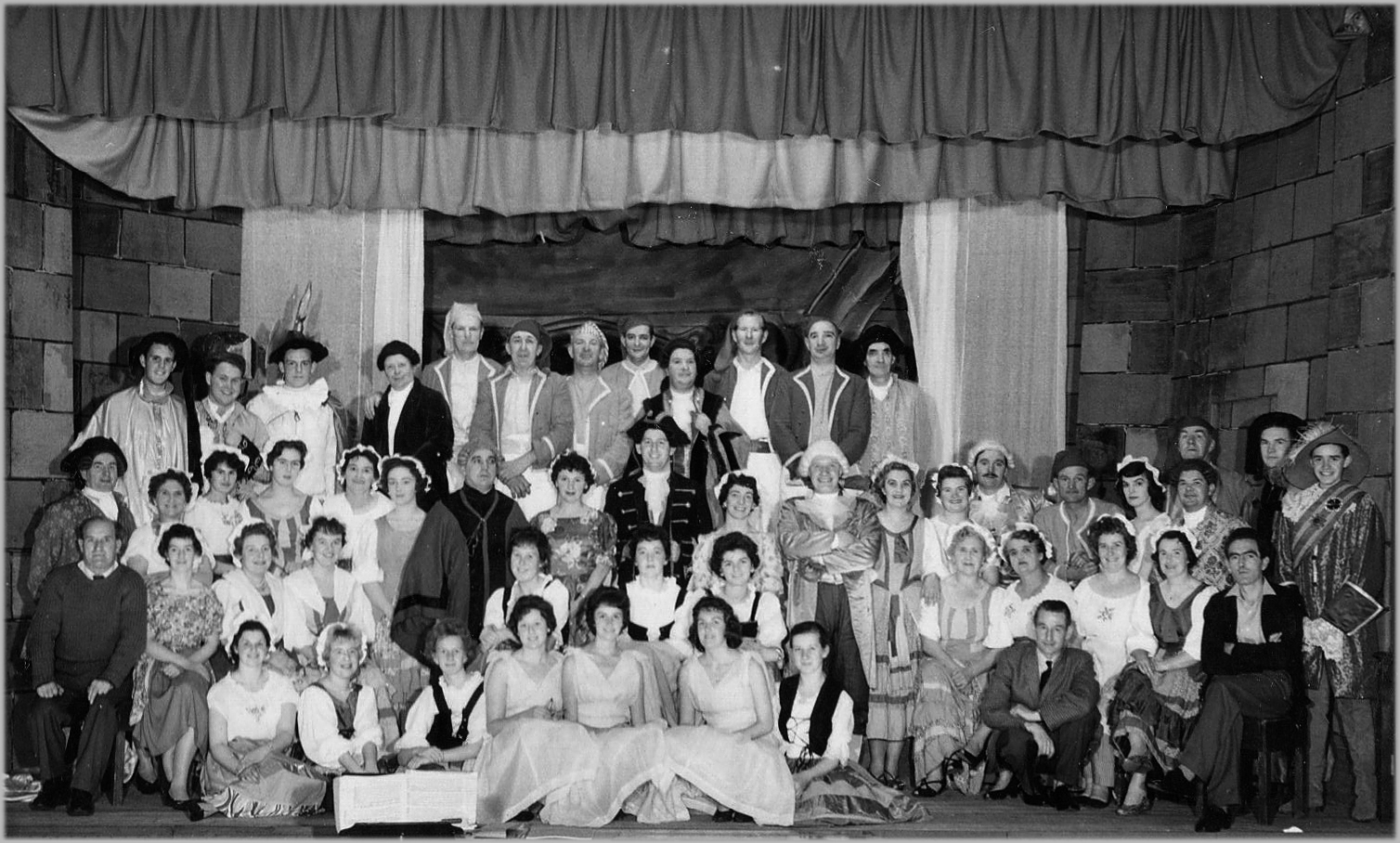
The year is 1960 – this new decade would continue to be a successful period for the Resolven and District Amateur Operatic Society, and the village of Resolven.
With some members leaving the village, some with ill health, or retirements etc. there were lots of changes taking place during this time in the Society, however, there was plenty of opportunity and interest for new members to join the Society as Resolven had two busy working factories, Cam Gears in the village and The British Aluminium Company, Rheola, which was in the vicinity of the Rheola House Estate with Collieries still employing many personnel at that time.
This created a very active little village as the two factories employed many hundreds of workers and staff which continued for many years, and added to the prosperity of the area.
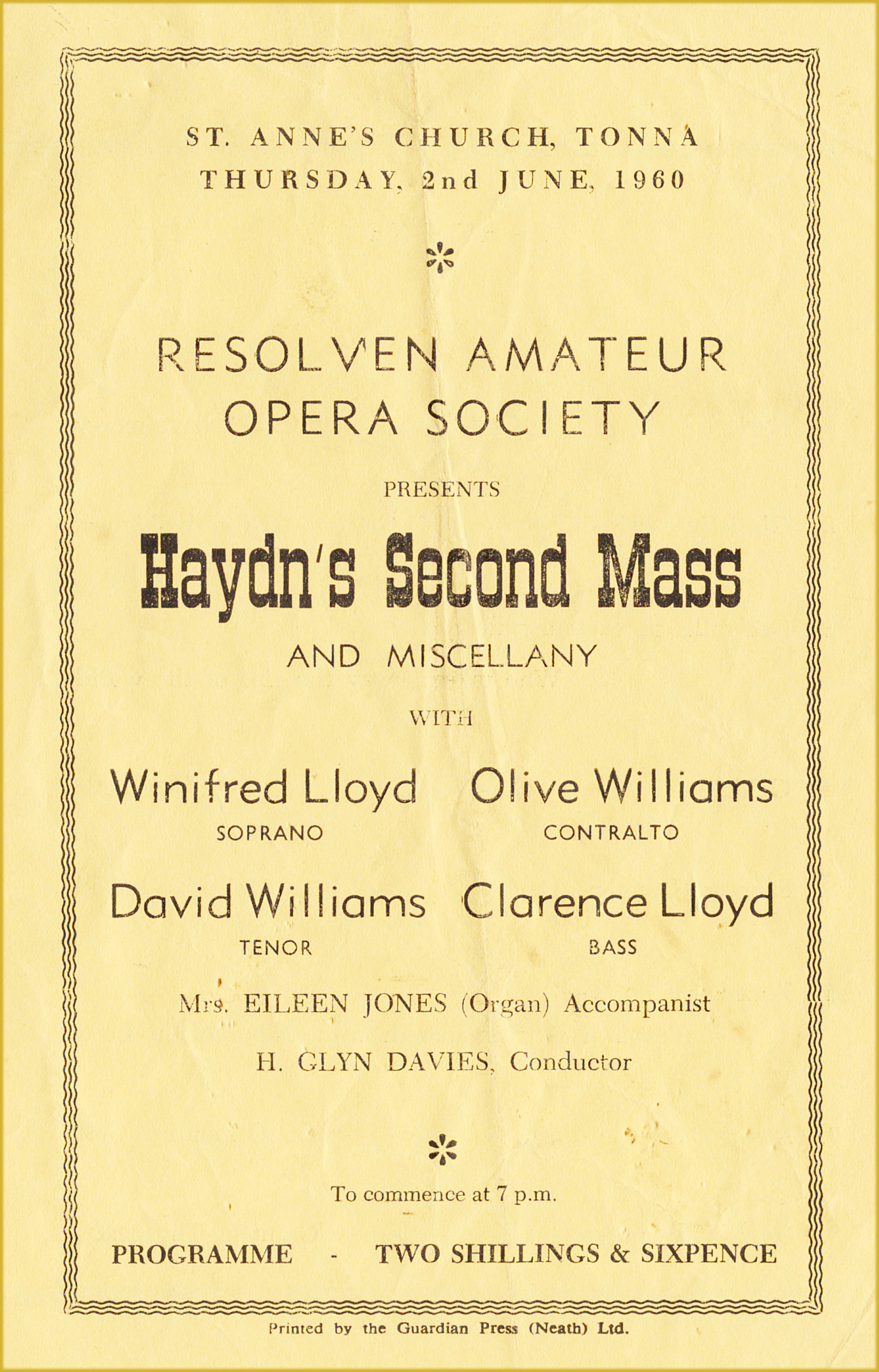
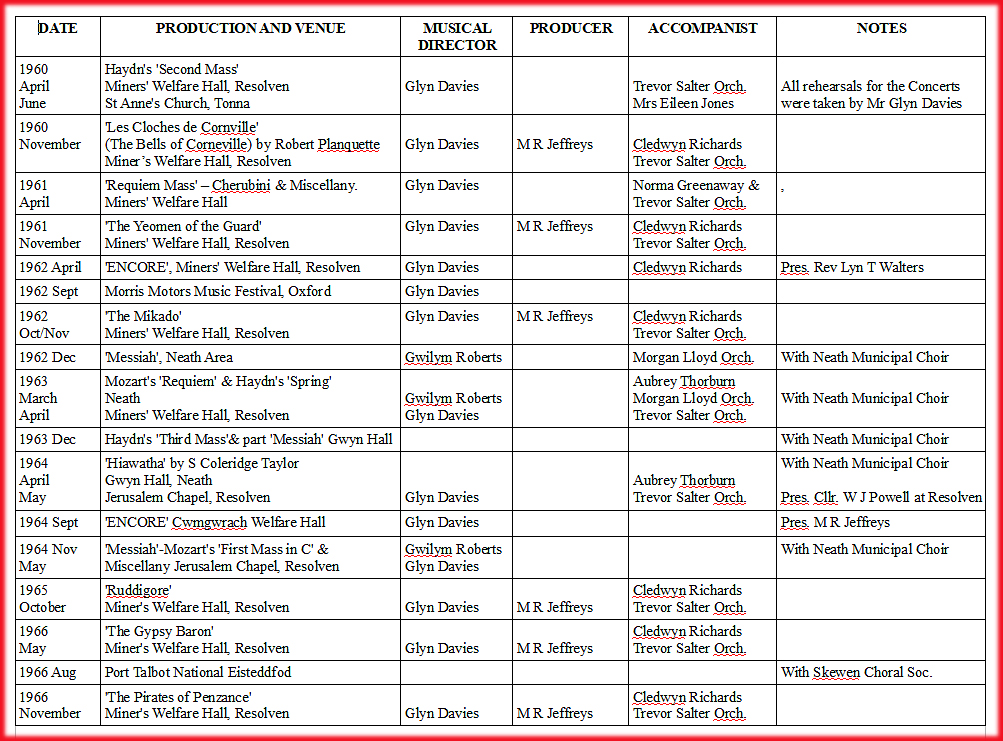
In the April of 1960, R&DAOS performed a concert of Haydn’s Second Mass in the Welfare Hall and in June in St Anne’s Church in Tonna.
In the Resolven concert, Trevor Salter Orchestra accompanied, while in Tonna, Eileen Gethin Jones was the organist.

~
The above photograph shows the full Cast and Chorus of the November Production of the comic operetta ‘Les Cloches de Corneville’ (The Bells of Corneville) by Robert Planquette.
This was a little known French operetta which had been translated to English recently from the French version. This is a light operetta in three acts with slight hints and a ‘nod’ to the work of Gilbert and Sullivan. The operetta has several large chorus numbers.
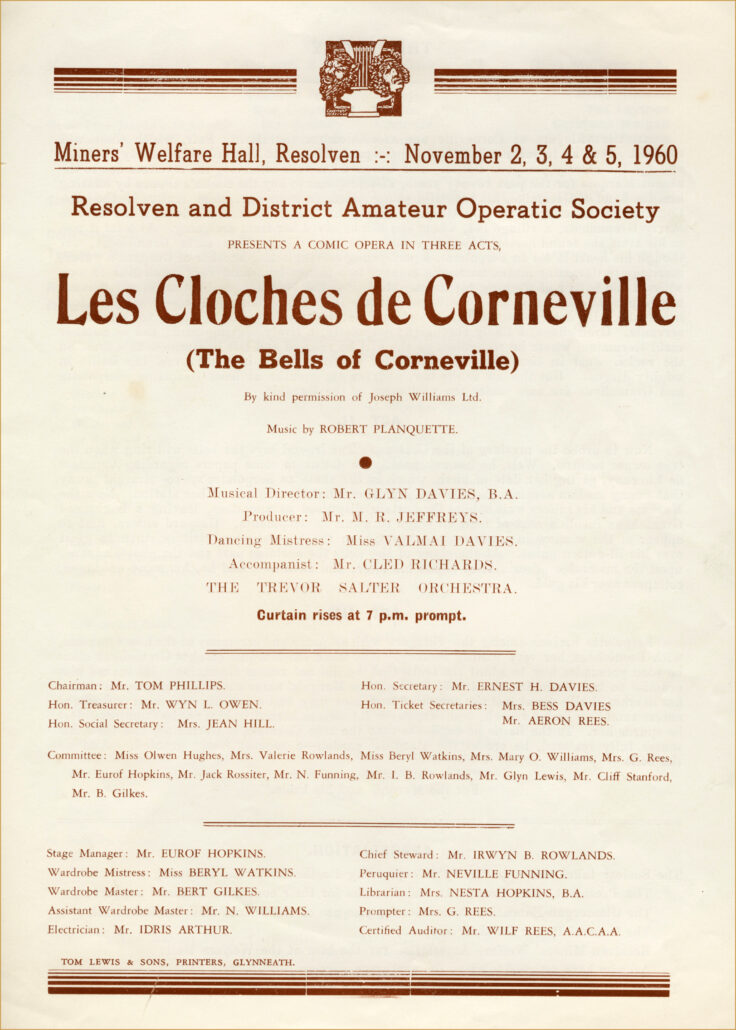

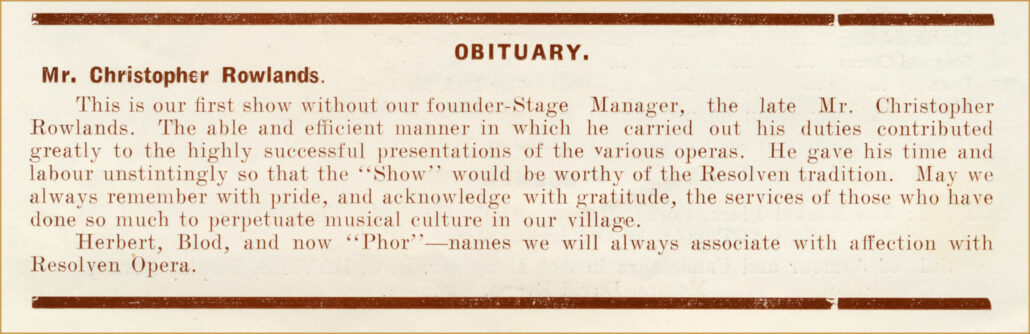
The Society had now grown in numbers and had developed quite a following from other Operatic Societies.
…………………………………………………………………
Les Cloches de Corneville was first performed in this country in 1878 first in London and then in Edinburgh in the same year.
Robert Planquette was a French Composer of songs and operettas.
Born in 1848 in Paris, he was the son of a Singer and educated at the Paris Conservatoire but did not finish his studies due to lack of funds. He worked as a Cafe Pianist and a Singer. In 1876 the Director of the Follies – Dramatique gave him a commision to compose his first operetta, Les Cloches de Corneville. It opened in Paris in 1877 and was extremely successful. It ran for 480 performances and then when it came to London, it ran for an astonishing 708 performances breaking all records at the time. He wrote 12 operettas and various songs. He died in 1903.

It is interesting to note that the first experiment in synchronising sound and motion pictures in 1894 featured one of the songs of the operetta Les Cloches de Corneville.
………………………………………………………….
~
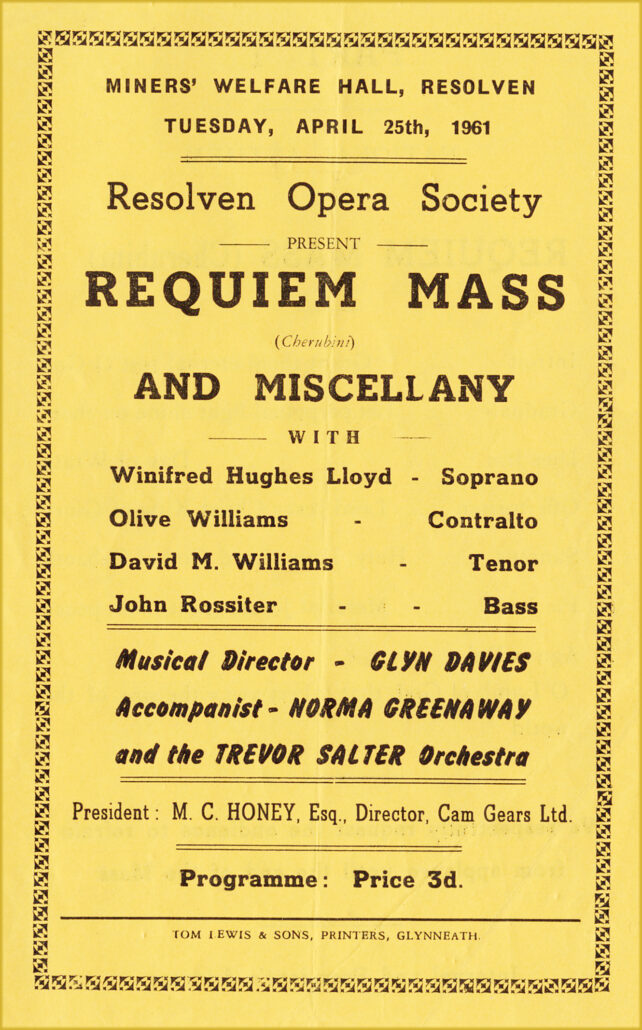
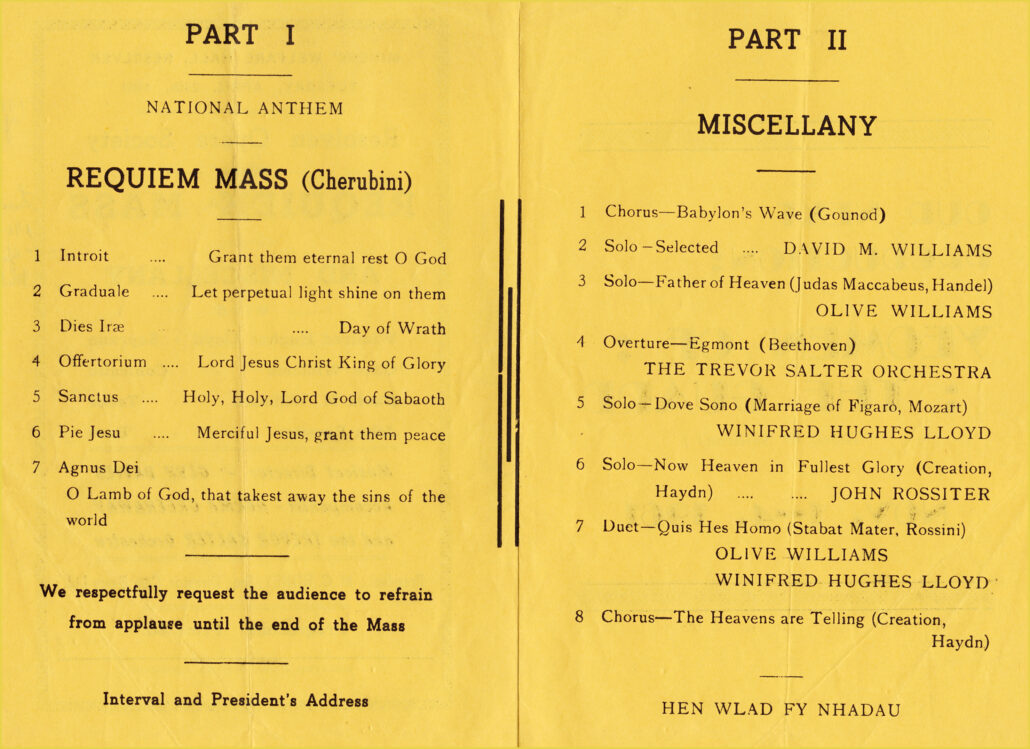
It had become custom and practice for R&DAOS to perform a concert to keep the interest of the members and ‘in good voice’ throughout the year, so for the 1961 Concert Mr Glyn Davies chose Cherubini’s Requiem Mass. The Concert took place on Tuesday 25 April 1961 with Society members as Soloists.
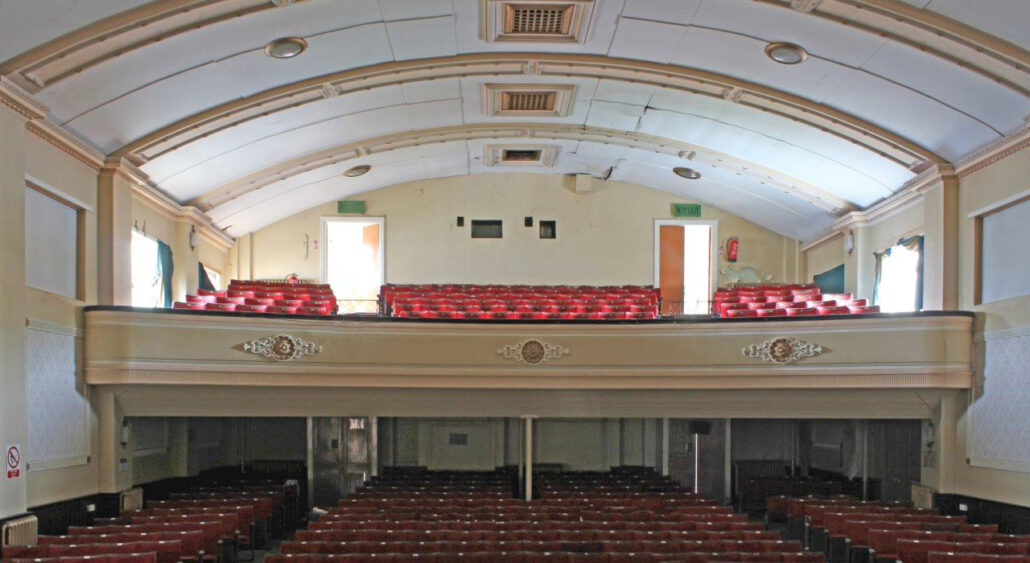
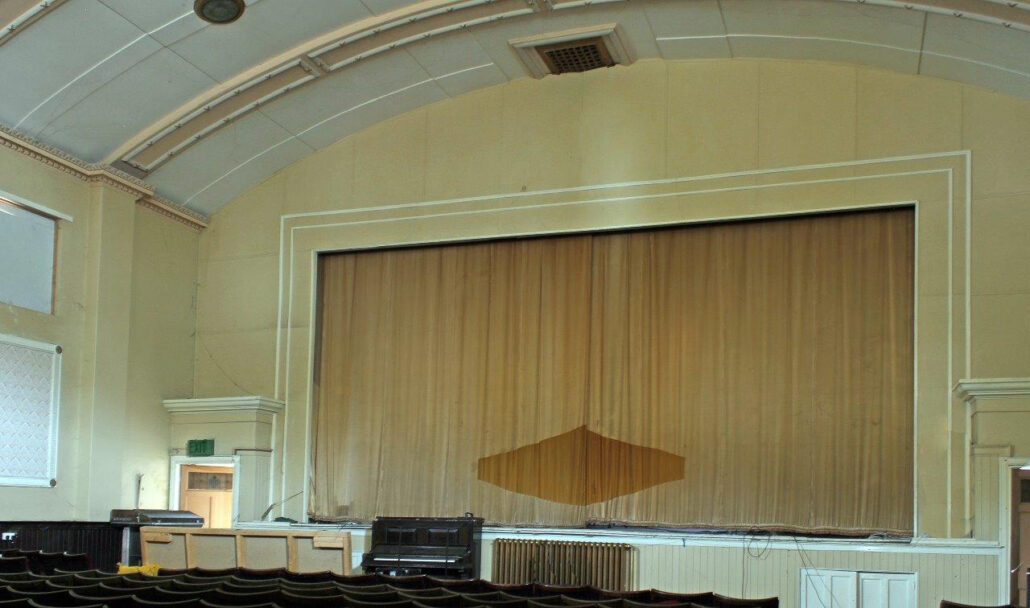
The above photo’s of the Auditorium of the Welfare Hall were taken by Mike Davies
At this time changes took place in the Officers of the Society.
Elwyn Summers was elected Chairman, Vivian Rowlands as Vice-Chairman and Secretary – Nesta Hopkins.
~
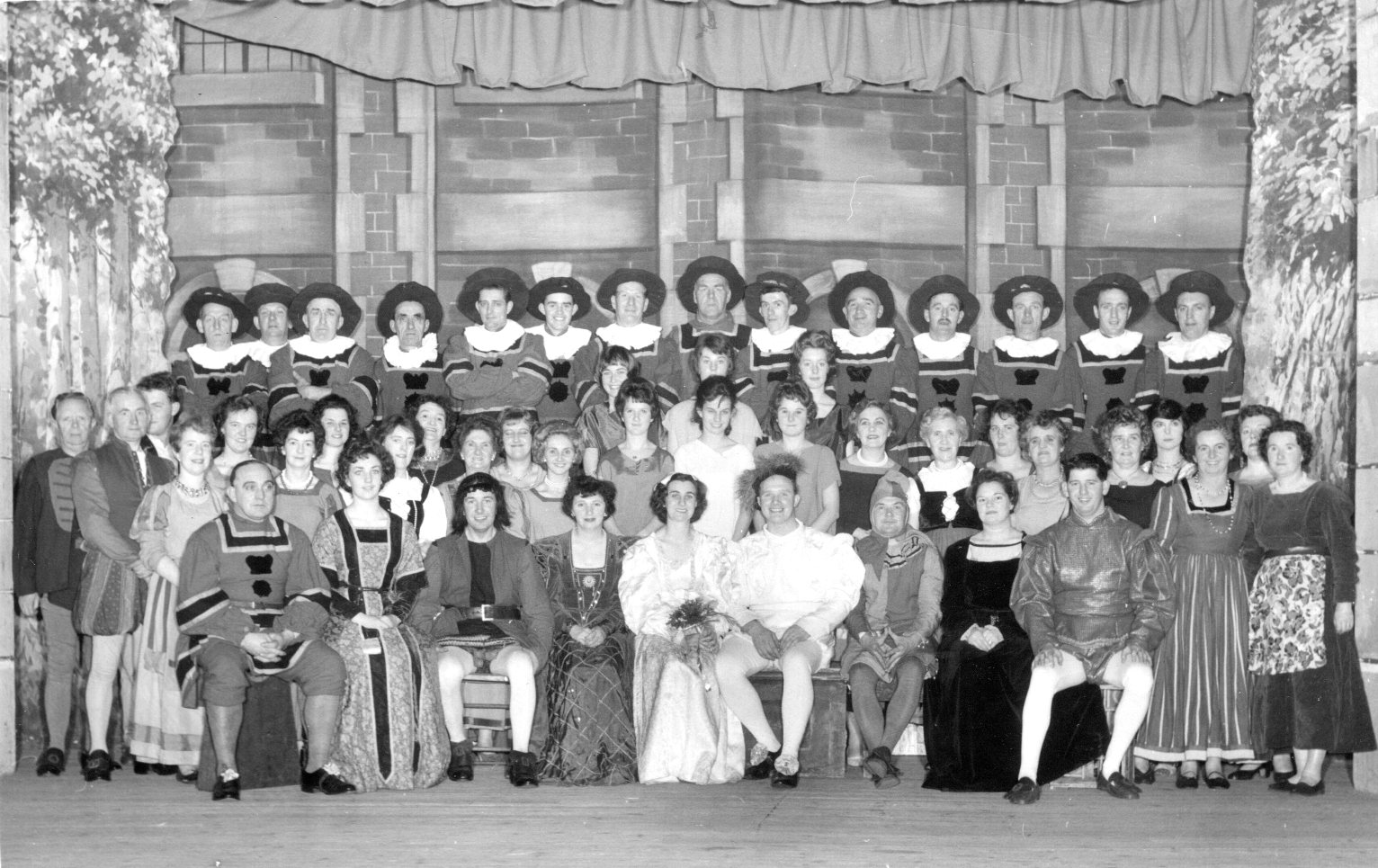
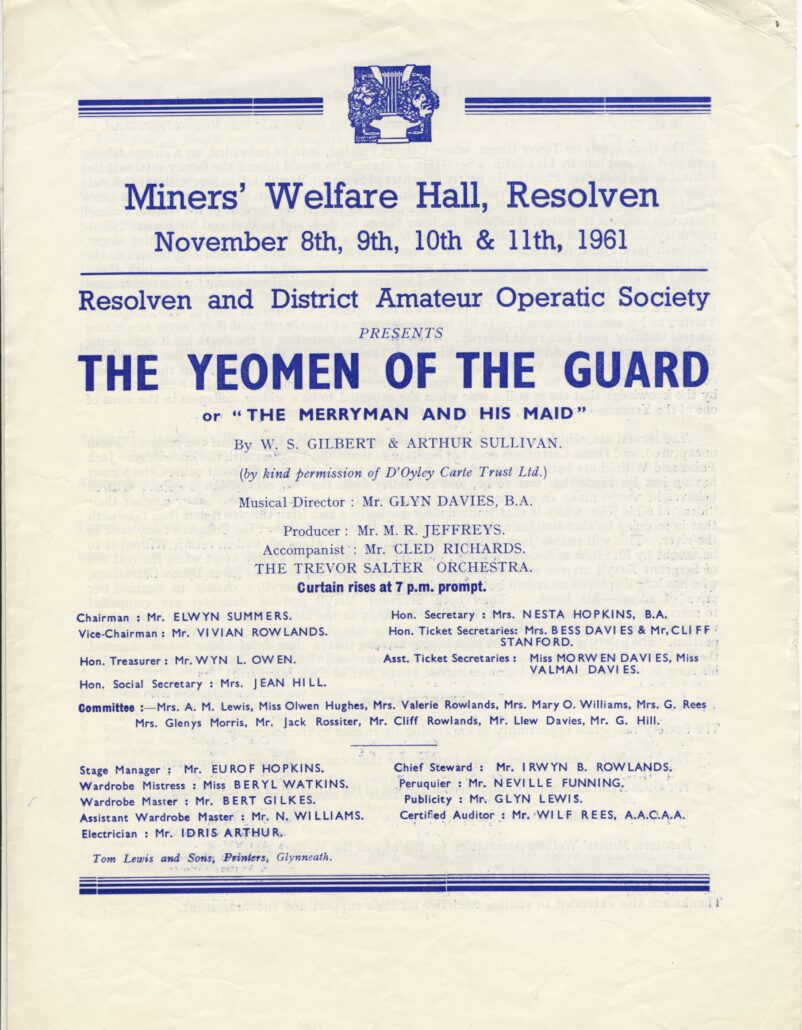
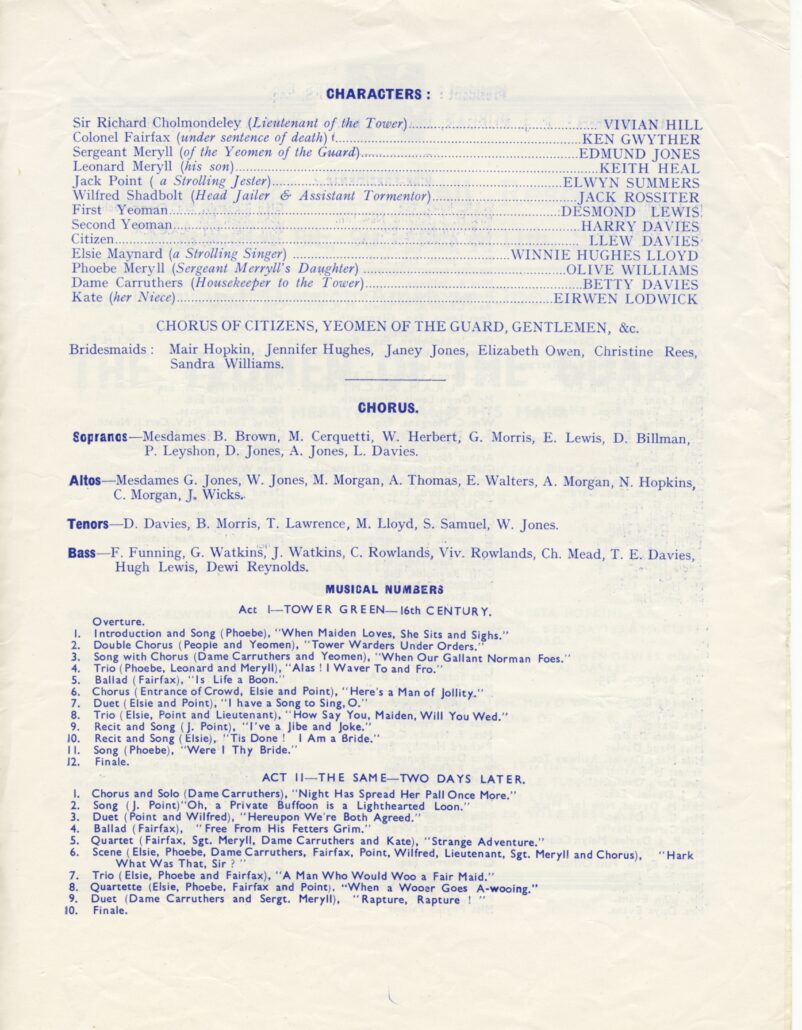
For the 1961 Stage Production there was a return to the Gilbert & Sullivan Opera ‘The Yeomen of the Guard’ performed from 8 -11 November at Resolven Welfare Hall. The performances Directed by long time member and local Teacher Mr Mervyn Jeffreys as always, were very well received by the public.
…………………………………………………………..
‘The Yeomen of the Guard’ often shortened to ‘Yeomen'(or ‘The Merryman and his Maid’) was written in 1888. Gilbert & Sullivan (known by many as Gee & Ess) were prolific in their writing and their Productions numbered fourteen Operettas performed as Savoy Operas.
‘Yeomen’ was a hit running for 423 performances in London and over a year in America and touring productions.
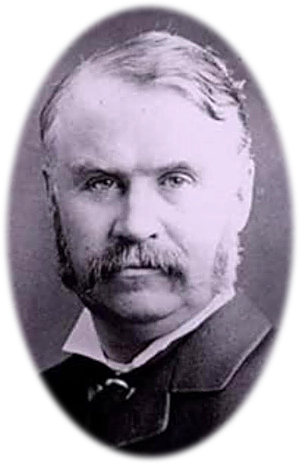
Famously incompatible dramatist W.S. Gilbert and composer Arthur Sullivan had many ‘fall outs’, as Sullivan always felt that his musical talent was wasted on comedy productions.

……………………………………………………………….
~
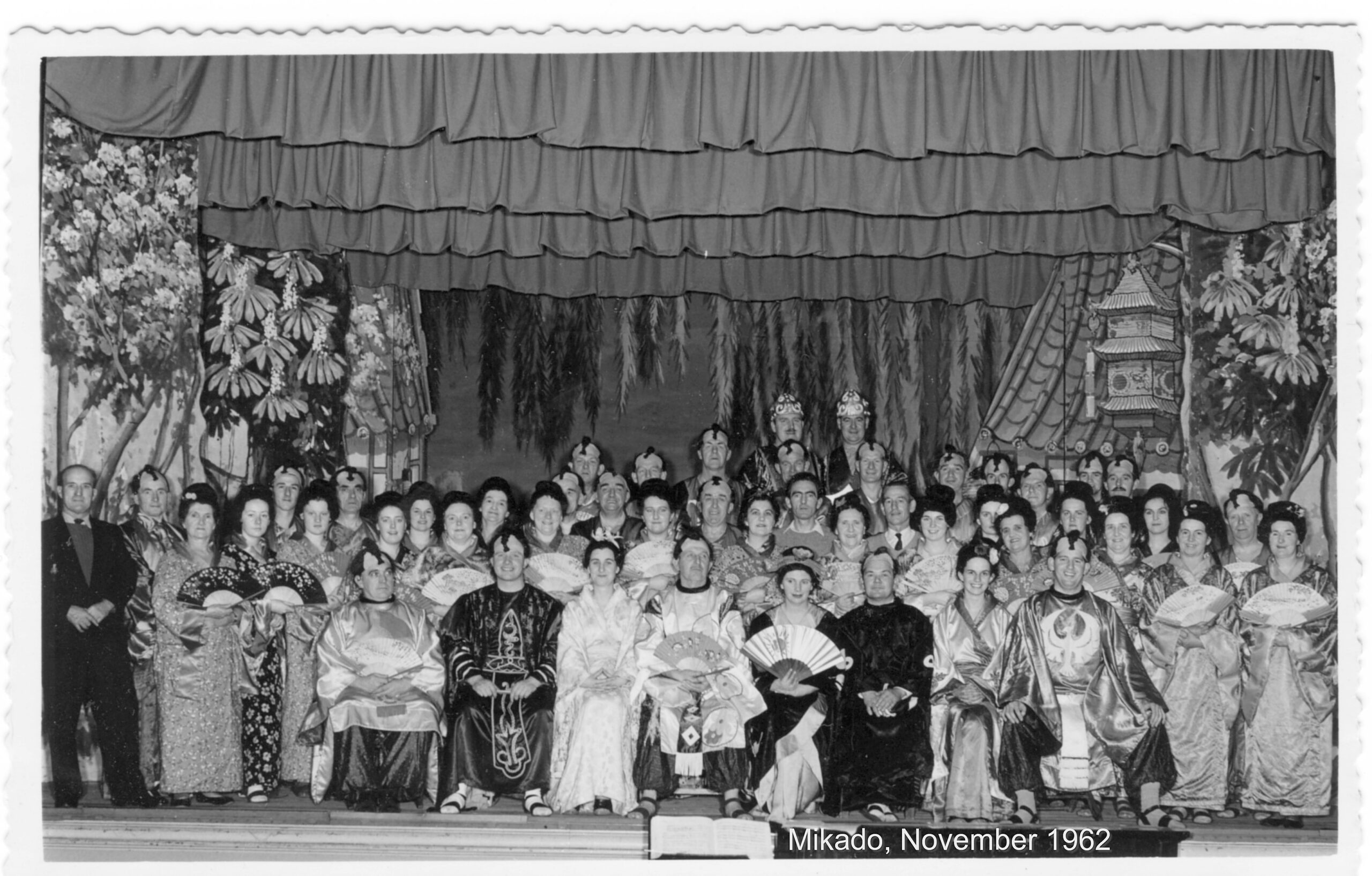
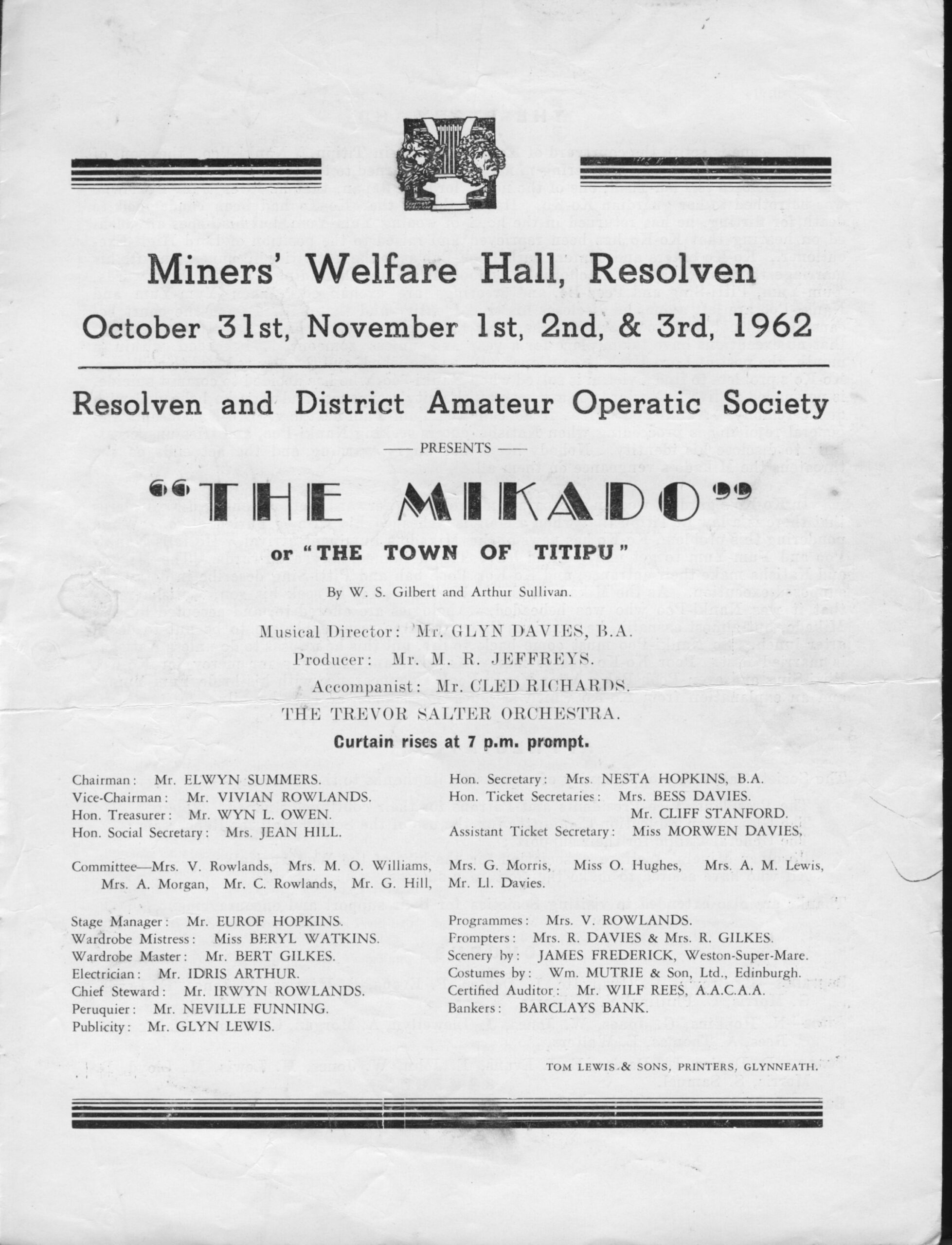
Following the success of ‘Yeomen’ the Society continued with a G & S Show for 1962 – ‘The Mikado’ (or ‘The Town of Titipu’) but this was a very busy year for the Society.
~
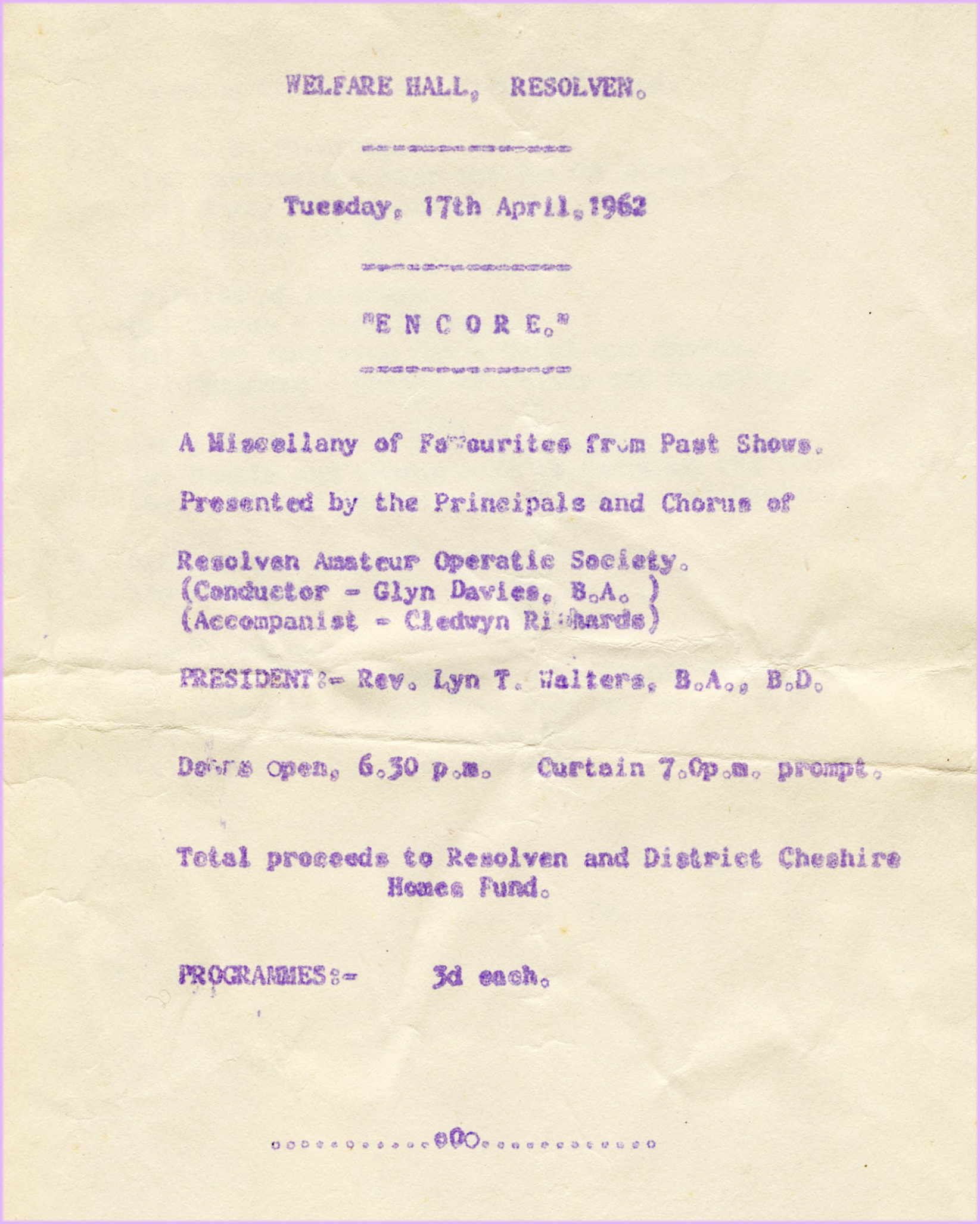
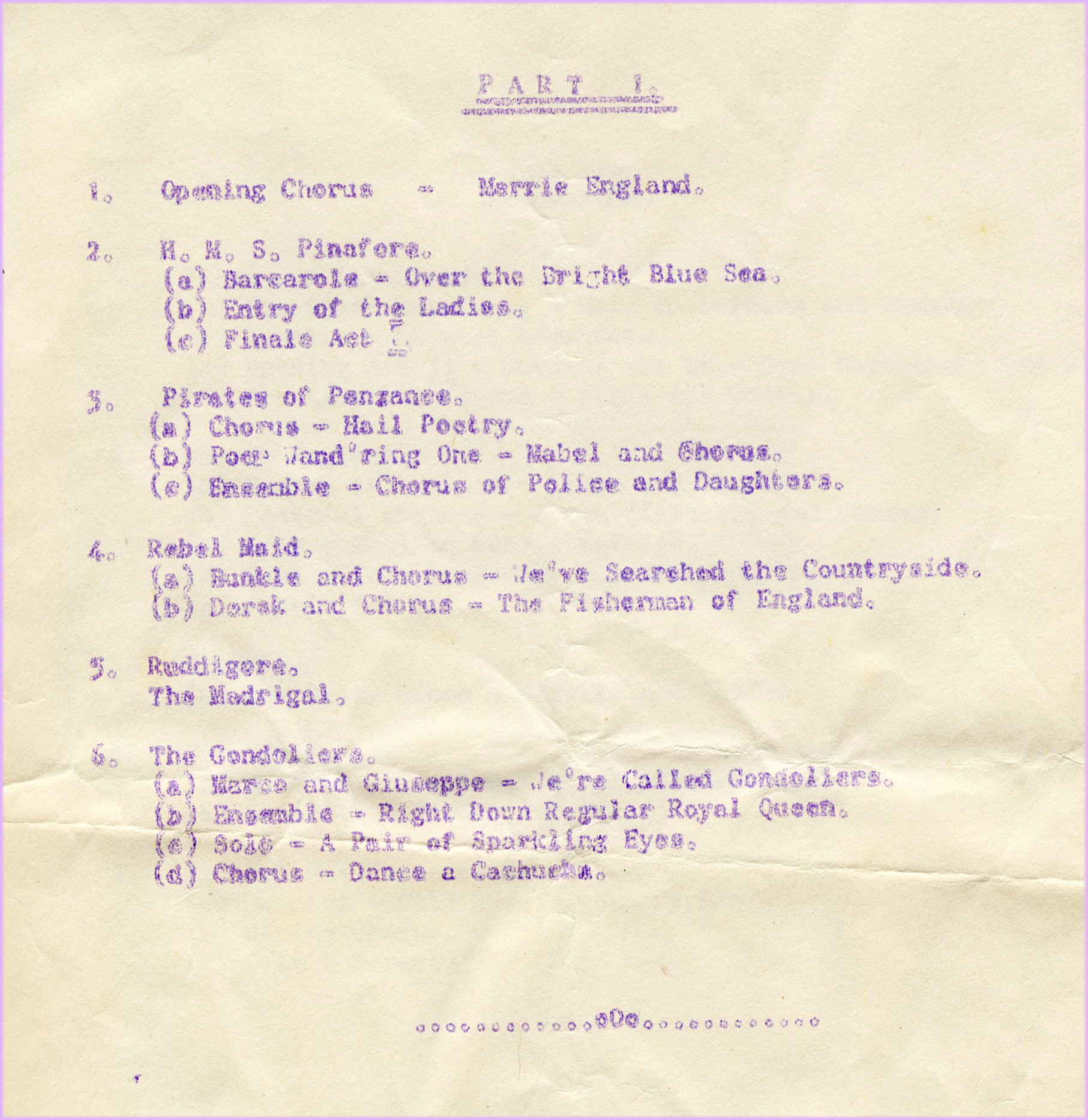
A request was received by the Society for a concert in the Welfare Hall in aid of the Resolven and District Cheshire Homes Fund. This took the form of an ‘Encore’ Concert, on Tuesday 17th April 1962, consisting of choruses, solos and ensembles from a number of operas already performed, soloists being principals who had taken part in those operas.

After that concert, it was suggested that the chorus should take part in a Music Festival run by Morris Motors, Oxford, and compete in the Mixed Voice Choir Competition. The expenses were borne by the Cam Gears Factory, Resolven.
The competition took place on Saturday, 29th September 1962. The choir gave a good performance but failed to take first place. However, two of the Soloists from the Society won their competitions, namely Olive Williams, Contralto, who sang “Where Corals Lie”(Elgar) and Jack Rossiter, who won Bass solo “Money-O” (Michael Head).
~
Resolven and District Amateur Operatic Society was the first society to take part in a Light Opera Competition sponsored by the Coal Industry Social Welfare Organisation in South Wales. The adjudicator on the night was Mr John Moody, Director of Production for the Welsh National Opera Company. The competition continued for months and the adjudication was not received until the following Summer. Dates of production were October 31st – November 3rd, 1962.

~
Neath Municipal Choir requested help with their performance of the ‘Messiah’ in December so as soon as the Opera Week was over, practices commenced for the concert. The performance was held on 13th December 1962 in the Neath area. Soloists included Stuart Burrows Tenor; and Nancy Richards, Soprano.
The last musical activity of this busy year was the carol singing which took place before Christmas. A party under Glyn Davies’ direction went around Resolven on two successive nights, with all the proceeds being given to Charity and good causes.
~
In 1963, the Neath Municipal Choir had decided to hold a concert in March and had again requested assistance from the Resolven Society, so it was thought advisable that the concert in Resolven in April should include the same programme, namely ‘Mozart’s Requiem’ and Haydn’s ‘Spring’ from ‘The Seasons’.
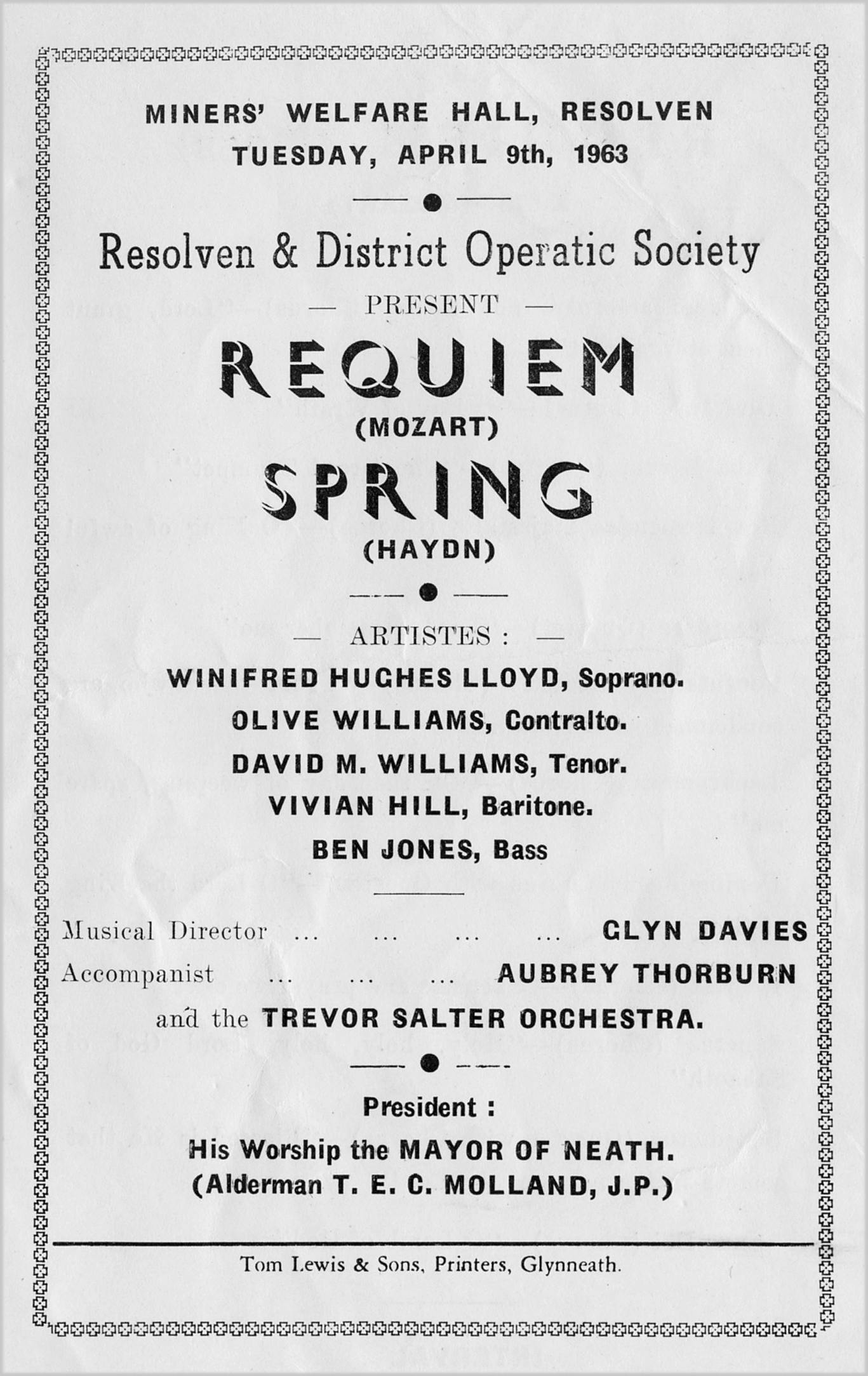
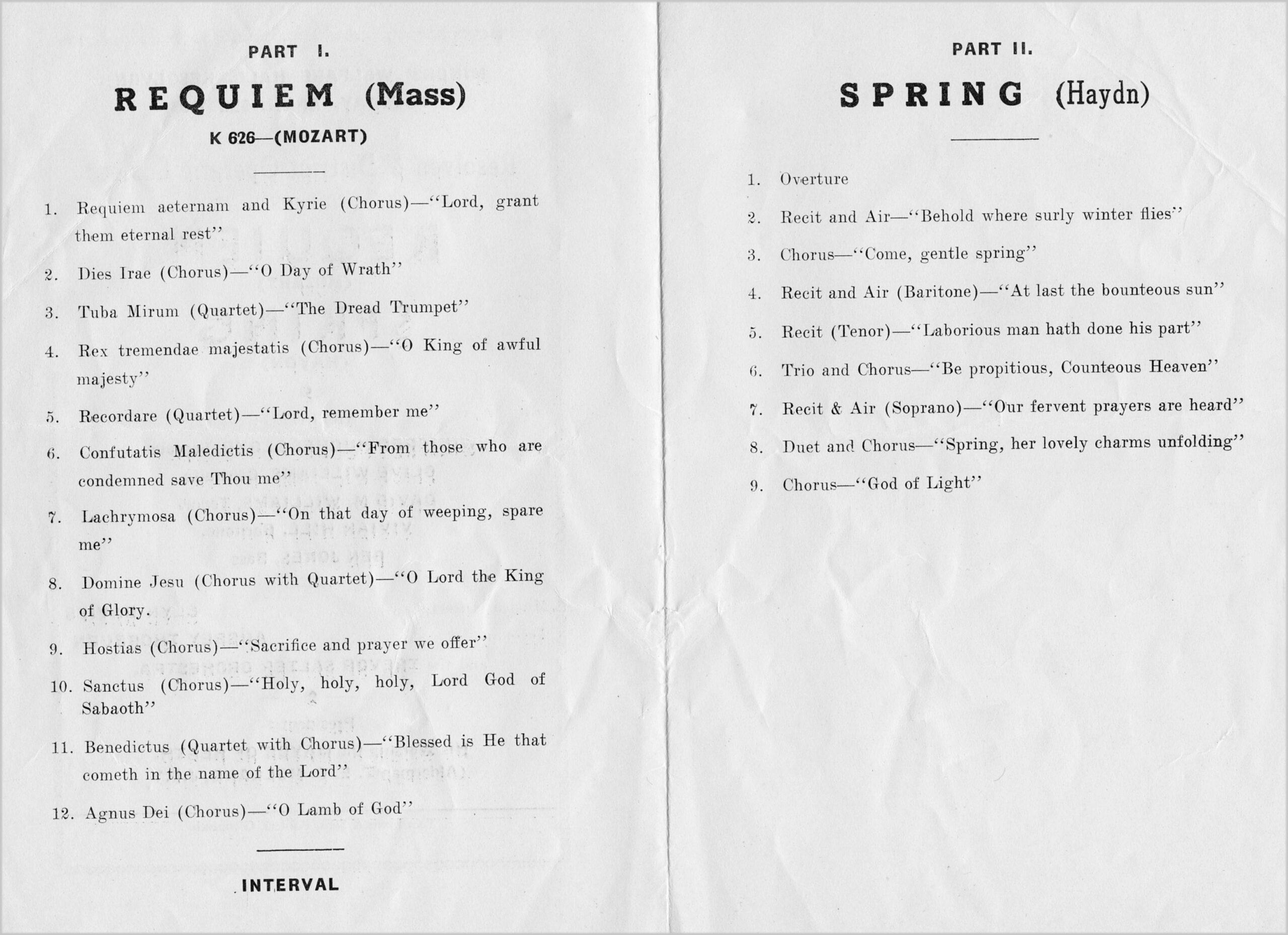
The performance in the Welfare Hall, Resolven took place on April 9th 1963 and was Headlined in the Neath Guardian on the 19th April as “Great tradition of choral singing upheld”. “Continuing their pattern of alternating light opera with the best of classical choral music, the Resolven Operatic Society…………maintained the great tradition of choral singing in Resolven.”
~
The choice for the November production was ‘The Gypsy Baron’ by Johann Strauss II. Rehearsals proceeded as usual, but by September 1963, it became obvious that there were many difficulties which made a November production doubtful. Some cast members had been ill, and there was poor attendance at rehearsals. Therefore, at an emergency meeting on 26th September, it was resolved to postpone ‘The Gypsy Baron’ and in the December it was decided to perform it in April or May of 1964 but when enquiries were made for possible dates for booking the Welfare Hall, there were several obstacles, the nearness of Drama Week being the most important, so the opera production was put off until November 1964.
In the meantime, the members interested joined the Neath Choir to perform the ‘Third Mass’ (Haydn) and the Christmas music from the Messiah. The concert was held at the Gwyn Hall in the December of 1963.
Once again though, at Christmas, a party of carol singers from the Resolven Society went around Resolven and collected for the Oxfam charity.
~
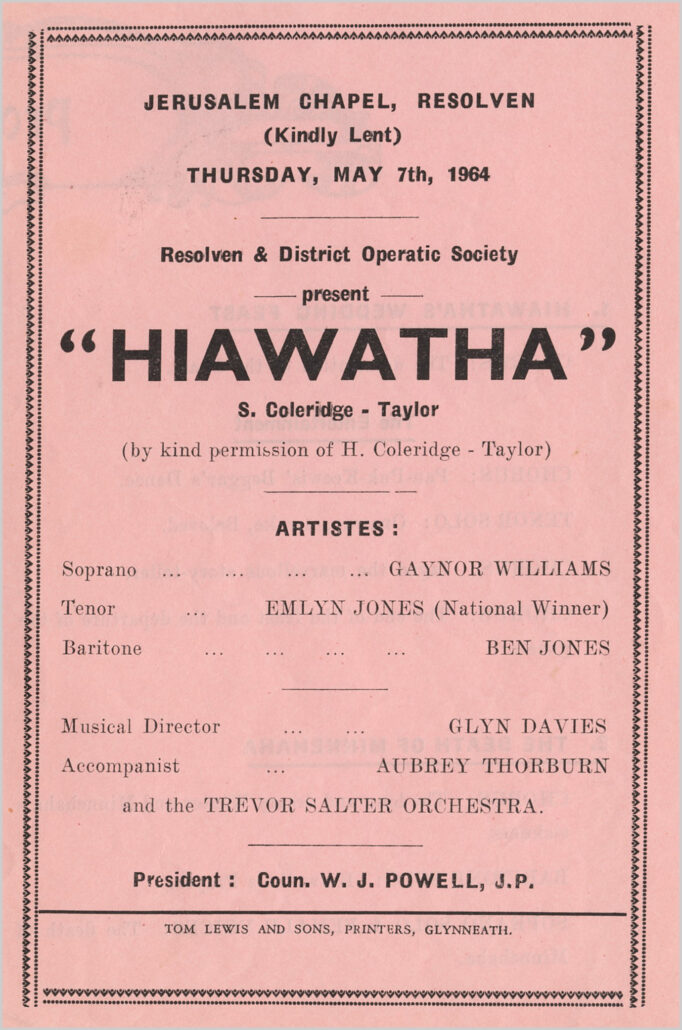
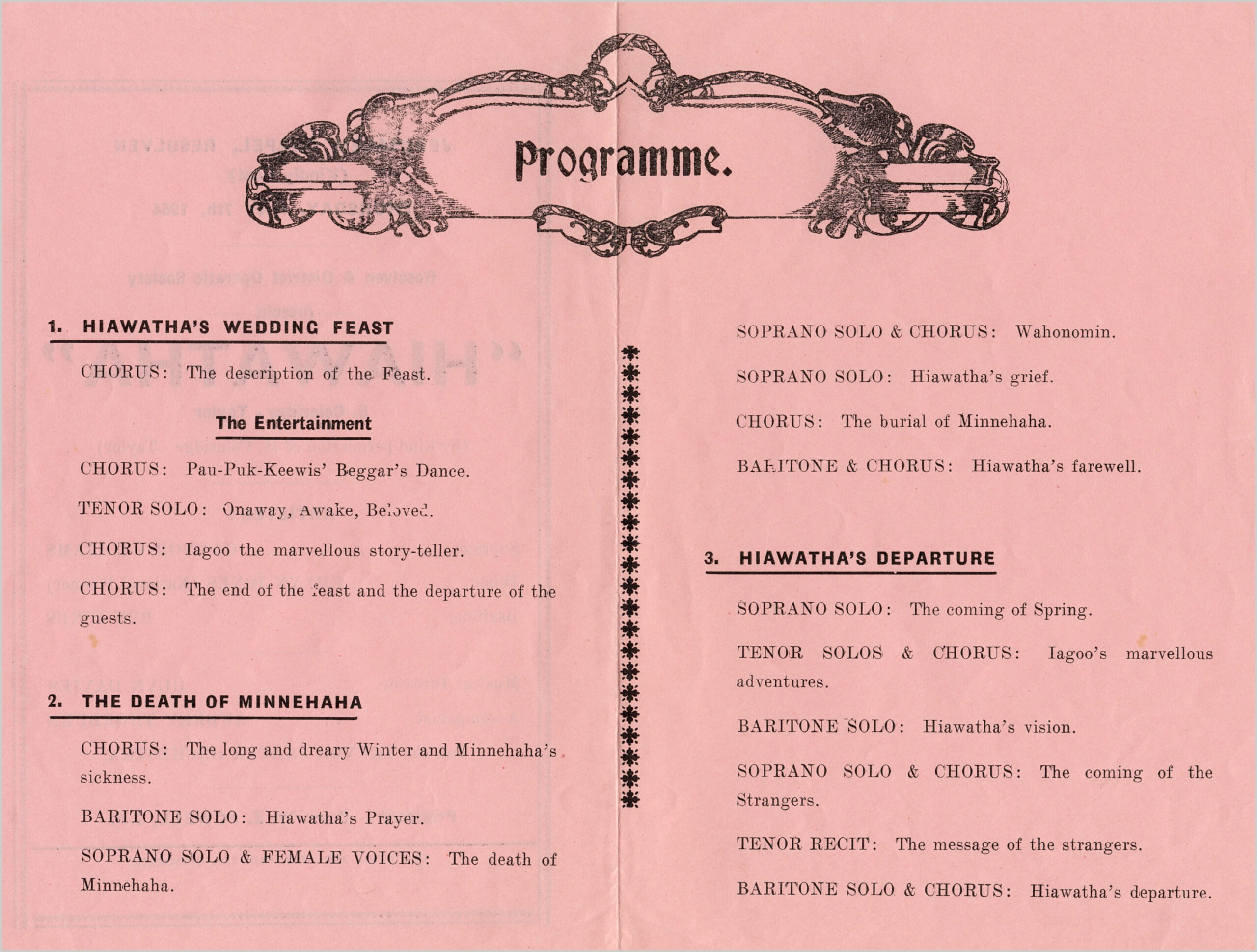
In 1964, the Neath Municipal Choir and the Resolven Society got together and decided to perform two concerts of ‘Hiawatha’ and to help each other with their performances. One concert was held in the Gwyn Hall in April, and the other in Jerusalem Chapel Resolven on 7th May 1964.
It was reported on Friday May 15th in the Neath Guardian that the Chapel “……..was filled to capacity for Resolven Operatic Society’s performances of “Hiawatha.” The Audience appreciated to the full the clear, controlled balance of this chorus work………..”. “Musically it was a most successful evening, maintaining the high standard which the Resolven Society have set themselves in the performance of concert works.”
~
After a request from Cwmgwrach Welfare Association an ‘Encore’ concert of songs and choruses from the shows was held in the Cwmgwrach Welfare Hall on the 16th September 1964 with Mr M R Jeffreys as compere.
Although December 2nd to 5th 1964 was fixed for the performances of ‘The Gypsy Baron’ again difficulties beset the rehearsals and therefore the Society postponed the production until a more suitable time.
No stage production was performed in these two years but most members were kept very busy rehearsing and singing in many concerts.
~
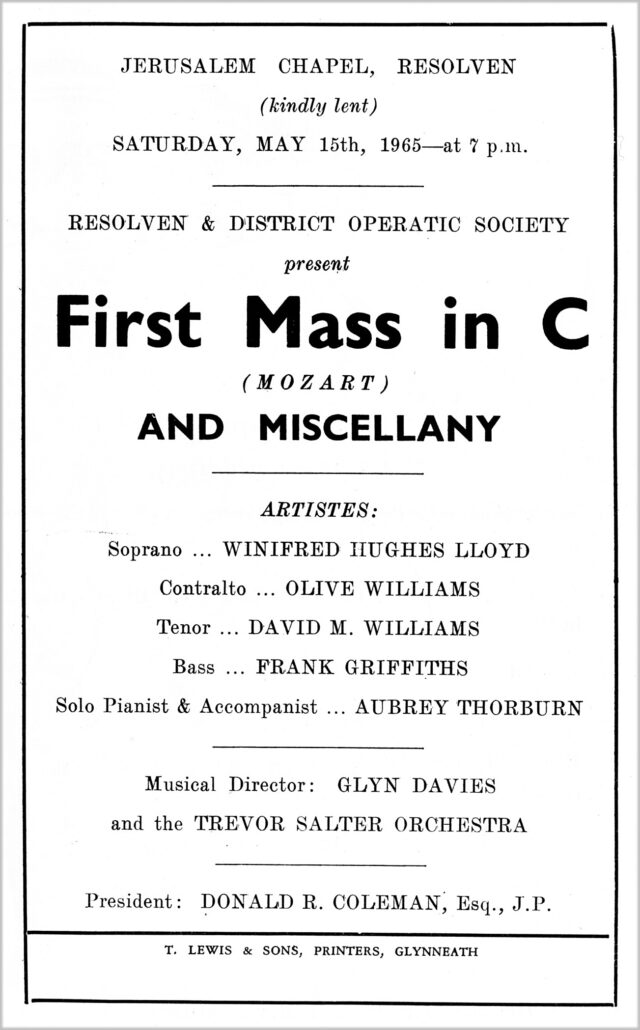
R&DAOS again assisted Neath Municipal Choir with the ‘Messiah’ on the 28th November 1964 followed by Mozart’s ‘First Mass in C’ and a Part II of Miscellany on the 15th May 1965 in Jerusalem Chapel.

~
After this concert rehearsals commenced for the G & S Opera ‘Ruddigore.
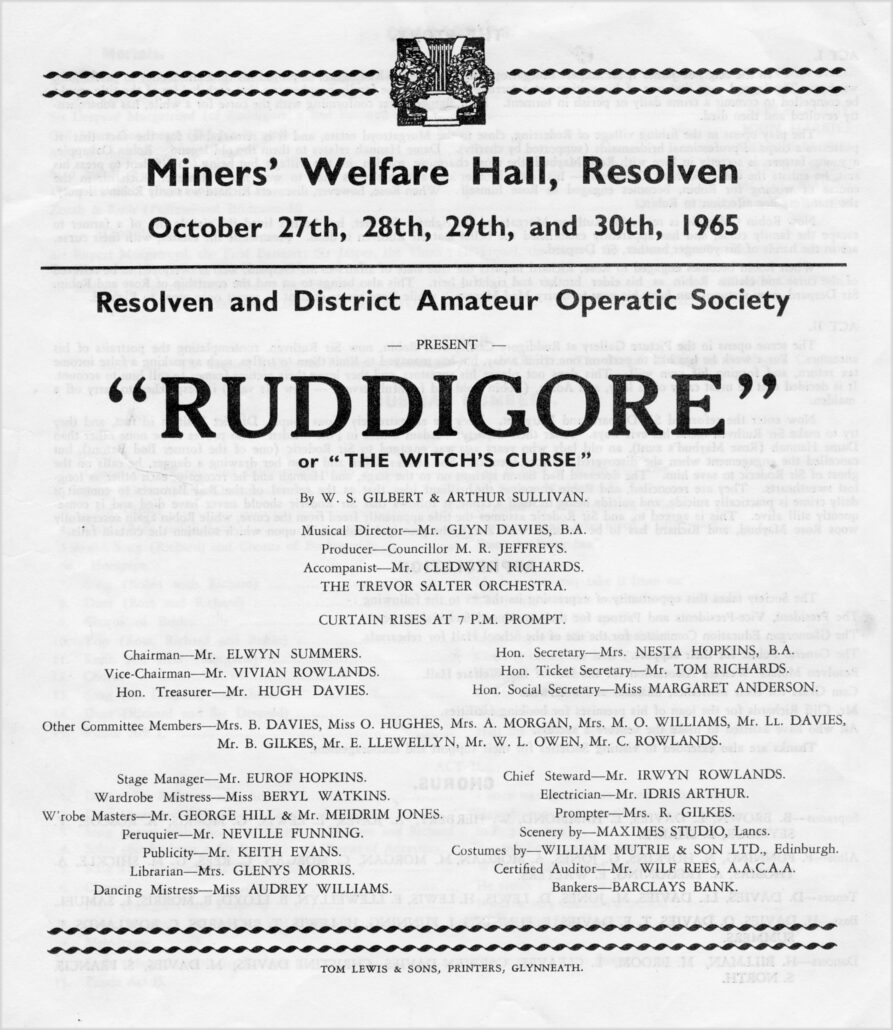
It was at this time, that several members of the Committee resigned due to ill health, namely Mrs Bess Davies (Founder Member) and Mr W I Owen, and Mr Tom Richards took over as Ticket Secretary with Mrs Glenys Morris assisting. Mr Hugh Davies took over as Treasurer. New Committee members were Mrs A Morgan and E Llewellyn.
Unfortunately, Miss Valmai Davies, due to various reasons, was unable to continue as Dancing Mistress. She had undertaken this work since 1953 setting a high standard with her dances and ballets, as well as assisting the cast with movements to music in many of the shows. Audrey Williams agreed to take over as Dancing Mistress.
Once again, the Society entered the Light Opera Competition, with each Society receiving a grant of £25 towards their costs.
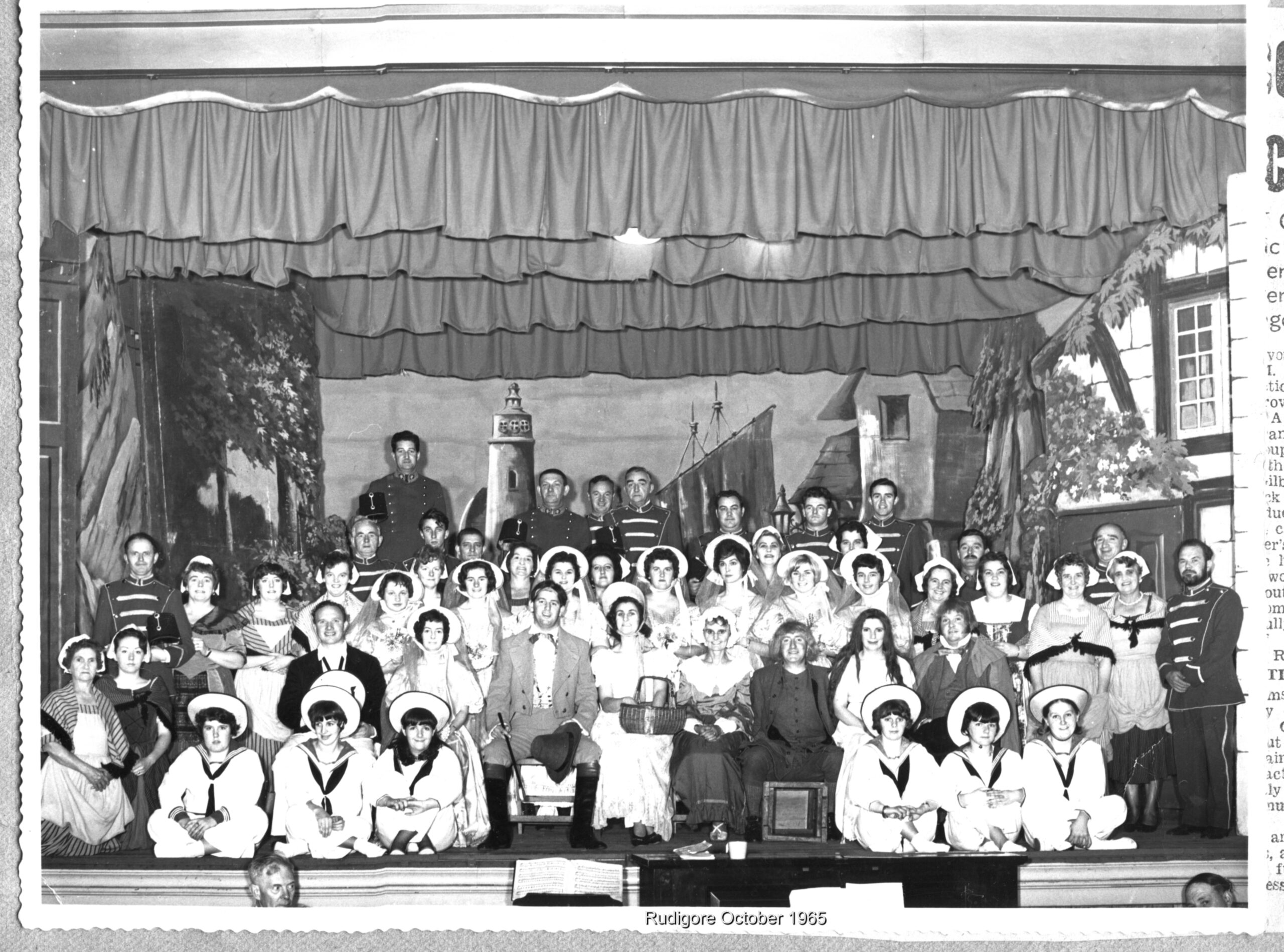
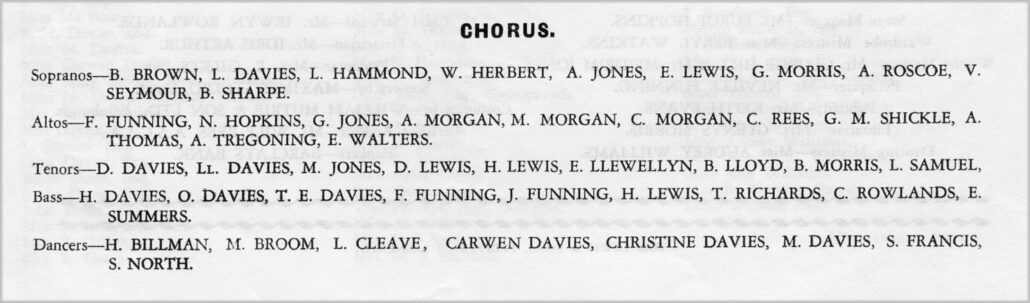
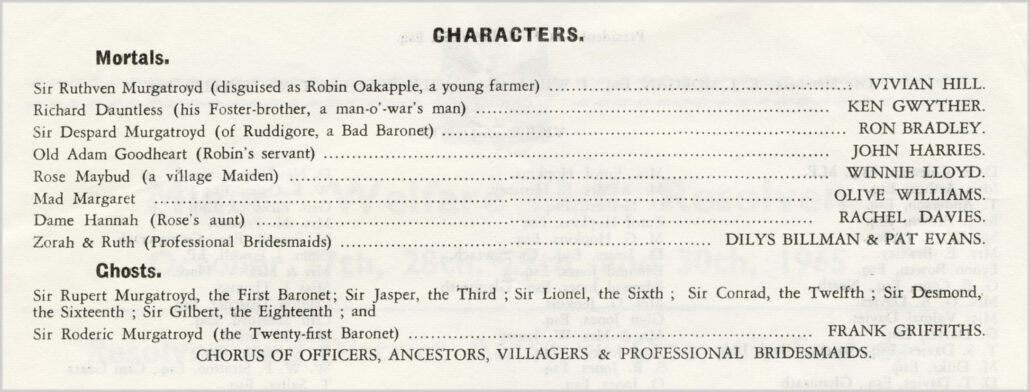
‘Ruddigore’ was performed from 27th to 30th October 1965.
……………………………………………………………
Ruddigore, (or The Witch’s Curse), originally called Ruddygore, is a comic opera in two Acts. It is one of the Savoy Operas and the 10th of the 14 Comic Operas written together by Gilbert and Sullivan.
Ruddigore is classed as unique among their works due to Mr Sullivan combining melody and harmony in the haunting opening chorus to the playful patter songs. It achieves moments of brilliance alongside passages that feel almost operatic in their drama.
………………………………………………………….
~
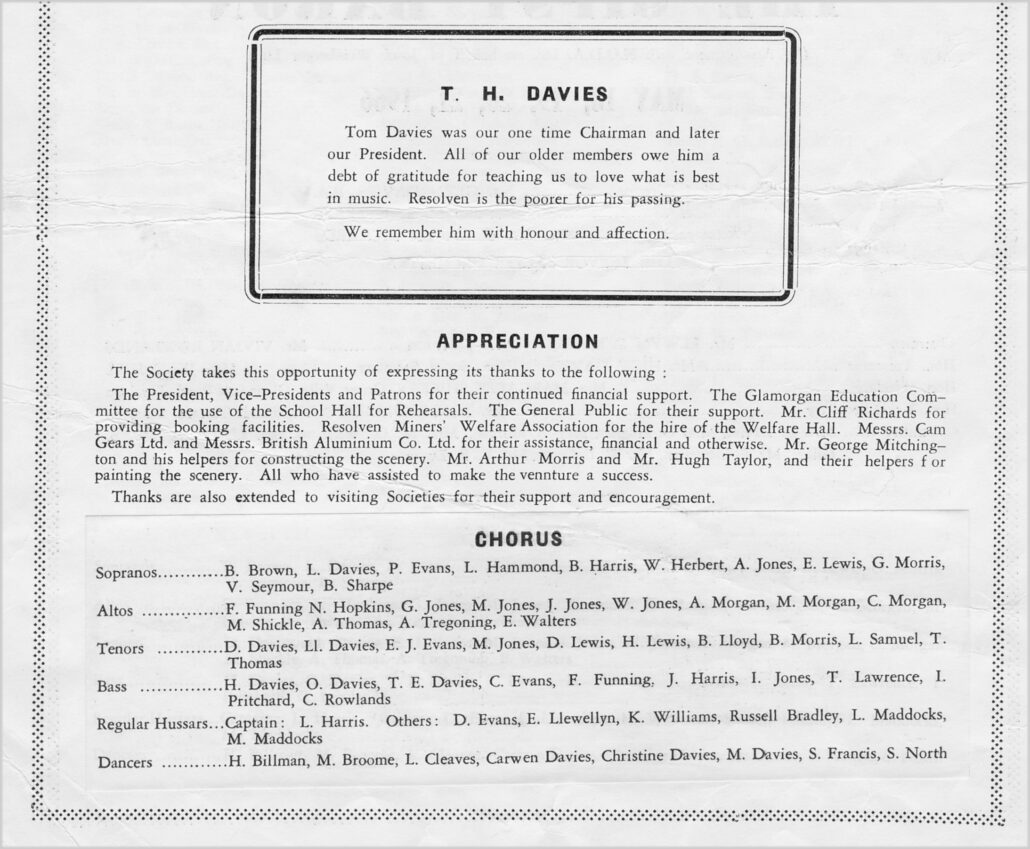
Before the next show, the Society sustained a sad loss when their President, Mr T H Davies passed away. Tom Davies was one to whom many of the older members of the Society owed a debt of gratitude for teaching them to love all that is best in music.
He had always been associated with the cultural activities of the village, and had served on the Committee of the Operatic Society since 1936. In 1948 he became Chairman of the Society and in 1955, its President. He is remembered with affection and that no greater tribute can be paid to him than to see his son Glyn Davies carrying on the tradition.
Mrs Bess Davies was chosen as President and in February 1966, she accepted a life membership with the Society.
There was great enthusiasm among the members after the show ‘Ruddigore’ so it was felt that the Society was now ready to put on ‘The Gypsy Baron’ in May 1966, which was a very new and different show for the Society to perform.
During this time, there were many more changes in the Society.
Mrs Nesta Hopkins resigned as Secretary due to medical reasons, and Mrs Margaret Shickle undertook the work. Mr Ernie Mayo became Asst Stage Manager, and Mrs Jean Hill, Social Secretary and Mr Vivian Hill became Deputy Producer.
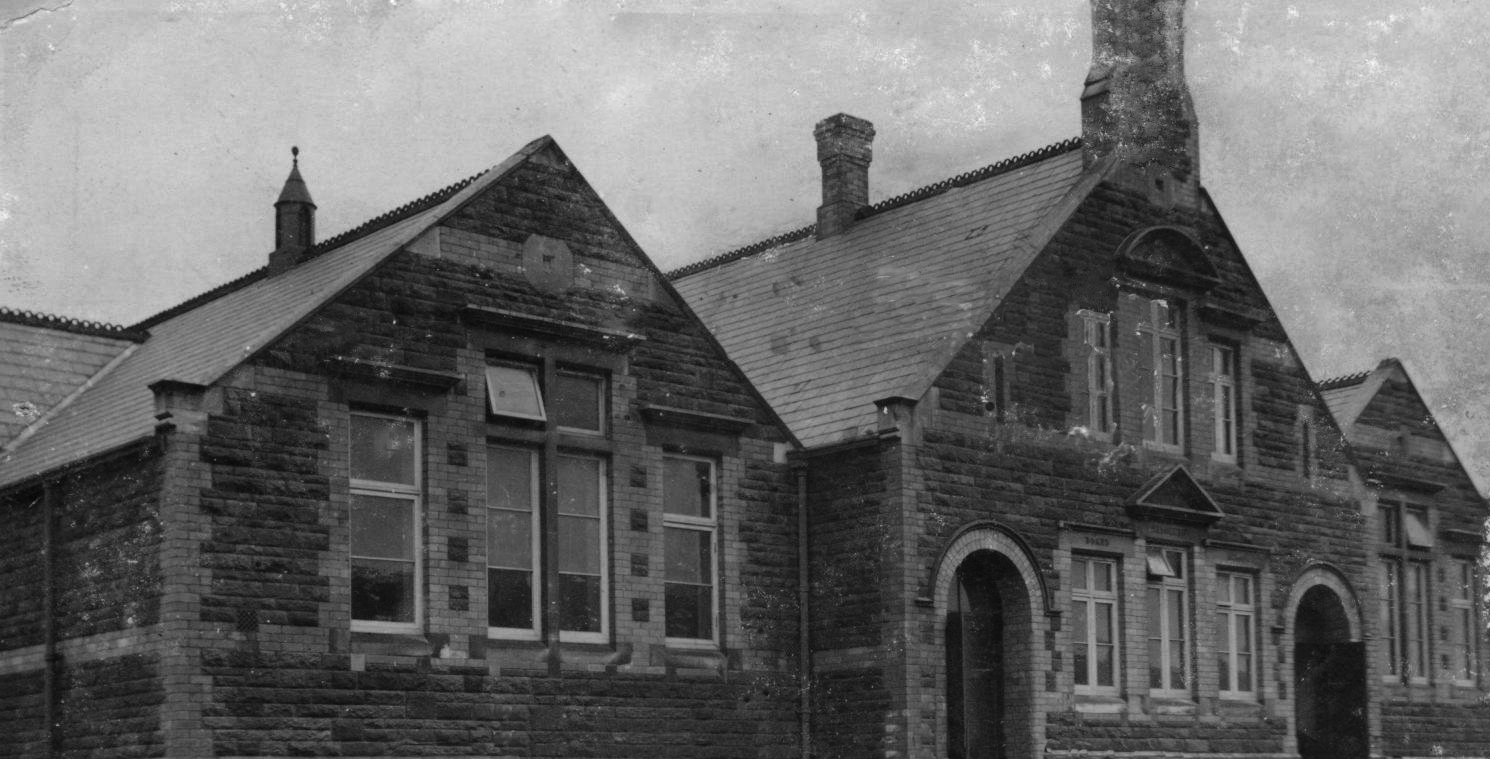
The scenery for the show was constructed by Mr George Minchington (Woodwork teacher at Resolven School) and his helpers, from timber supplied free of charge by the British Aluminium Company and painted by Mr Arthur Morris (Art teacher at Resolven School) and Mr Hugh Taylor with help from other Society members.
The chorus was enlarged for this show, and ladies of the chorus agreed to make their own gypsy and villagers’ costumes to save expense. Materials for the costumes were supplied by Miss Beryl Watkins and Mrs Christine Davies. A tribute must be paid to Christine for the many ways she aided the Society, when extra costumes and curtains were needed for a number of shows. A weekly raffle was organised to help with expenses.
…………………………………………………………………….
Johann Strauss II also known as Johann Strauss Junior or the Younger was an Austrian Composer of light music, particularly dance music and operettas. He was also an accomplished Violinist. He composed over 500 waltzes, polkas, and other types of dance music, and several operettas and a ballet. During his life, he was known as ‘the Waltz King’ as he played a major role in making the Waltz popular in the 19th Century.
His most famous piece is The Blue Danube Waltz which he originally wrote as a choral piece to uplift the people of Vienna who had lost in the Austro-Prussiian War. His inspiration to write it came from a Poem written about the Danube. The Blue Danube Waltz is now considered to be the most famous waltz of all time.
There has been a Johann Strauss Society of Great Britain since 1964, which is still active today.
Johann Strauss II was born in October 1825 in Vienna and died there at the age of 73 in 1899.
…………………………………………………………………
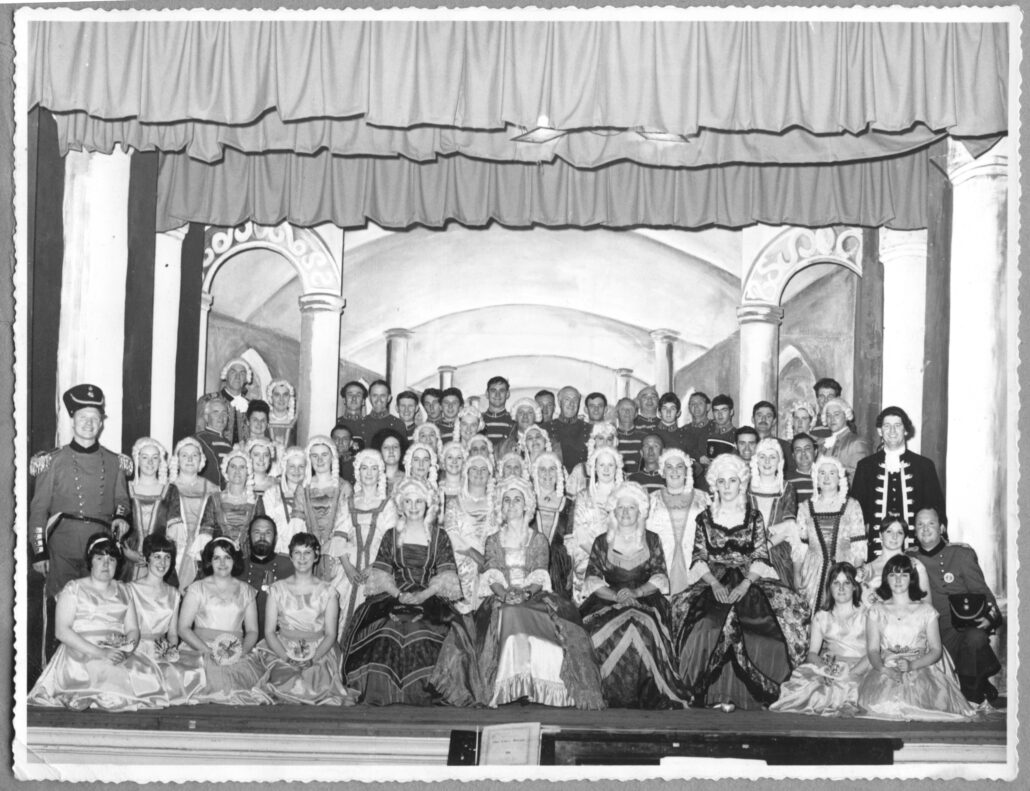
At that time, perhaps because ‘The Gypsy Baron’ was new to the Society, and such a big demanding show, the Community came together to produce one of the most entertaining and happy shows for all who were involved in it, and the Cast and Chorus were one of the largest in number for this production.

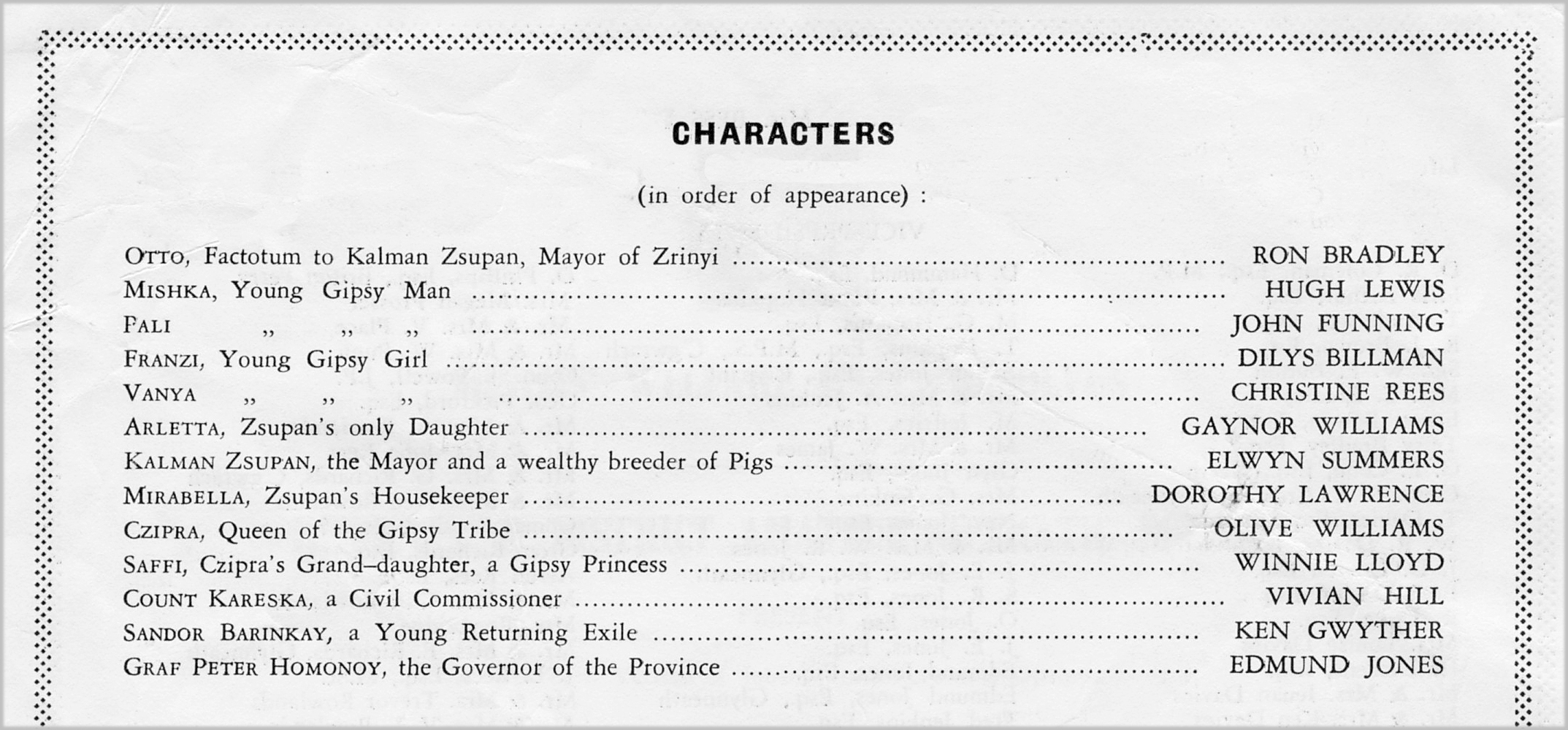
The Society performed to a packed audience every night. It is now considered to be one of the most successful shows ever seen on the Welfare Hall Stage.
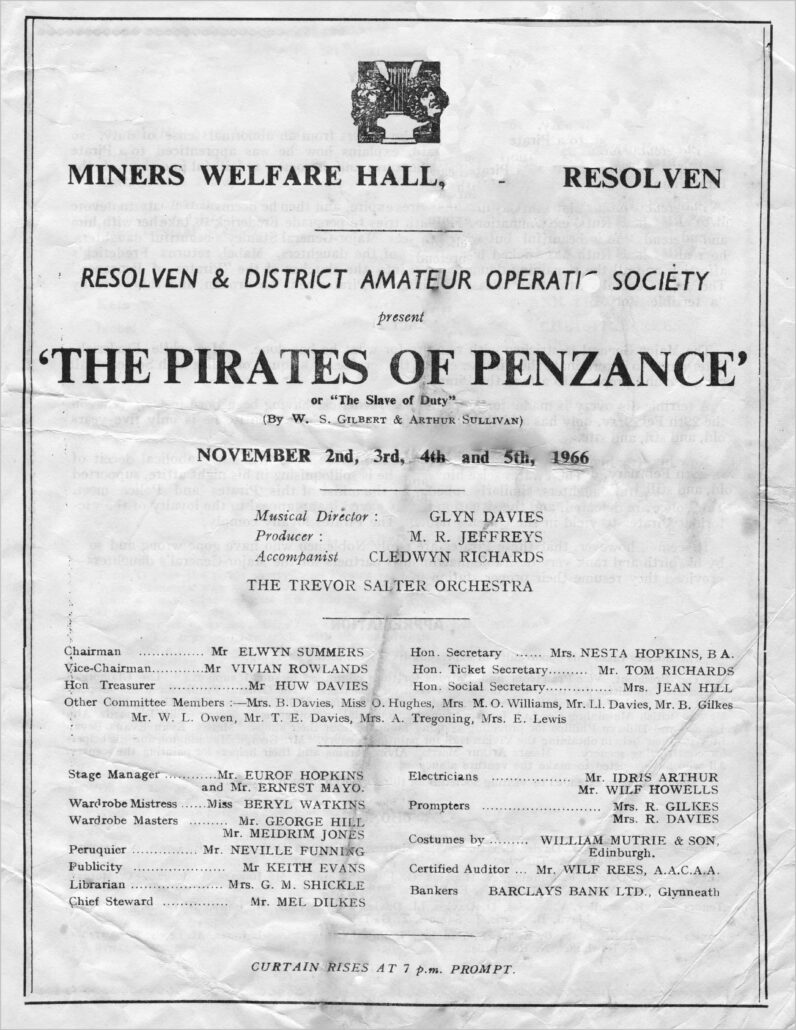
Following the success of Gypsy Baron, the decision was taken to put on another show in the November, the ever popular Gilbert and Sullivan’s ‘Pirates of Penzance’. Before that, however some Society members were busy rehearsing with Mr Glyn Davies for the Skewen Choral Society, who had requested assistance again, to enable them to compete in the Port Talbot National Eisteddfod in August of 1966 in the Mixed Choral Competition. The Choir was not successful in the competition, but the Resolven section of the Choir enjoyed the interesting experience.
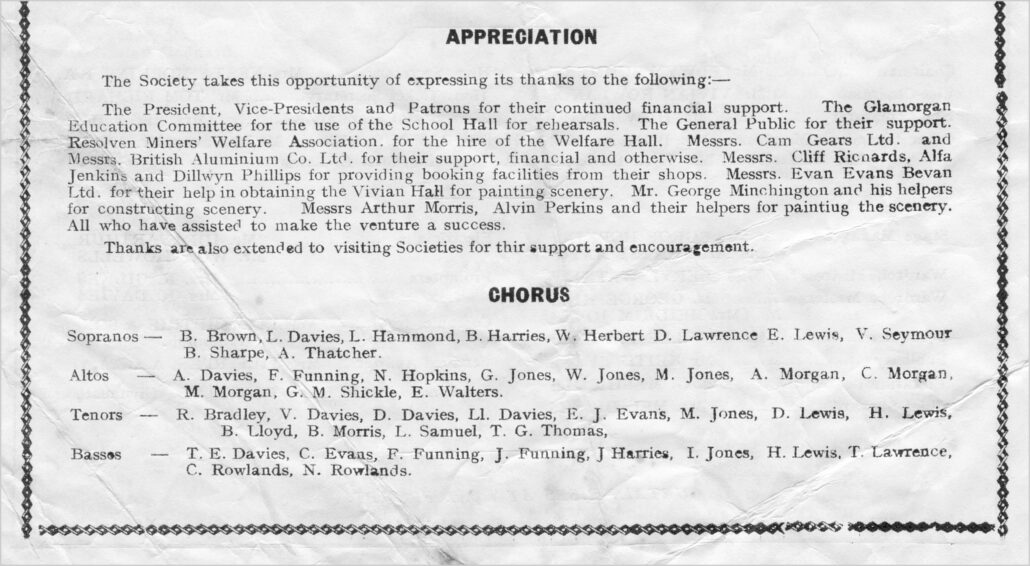
During this time, there were several changes in the Committee members of the Society and Mrs Nesta Hopkins once again took on the secretarial work. The Chief Steward was Mr Mel Dilks, and the Committee members were Mrs Ann Tregonning, and Mrs Eunice Lewis. Mr Wilf Howells joined Mr Idris Arthur as Electrician for the Society, continuing the family tradition of his father Mr R D Howells.
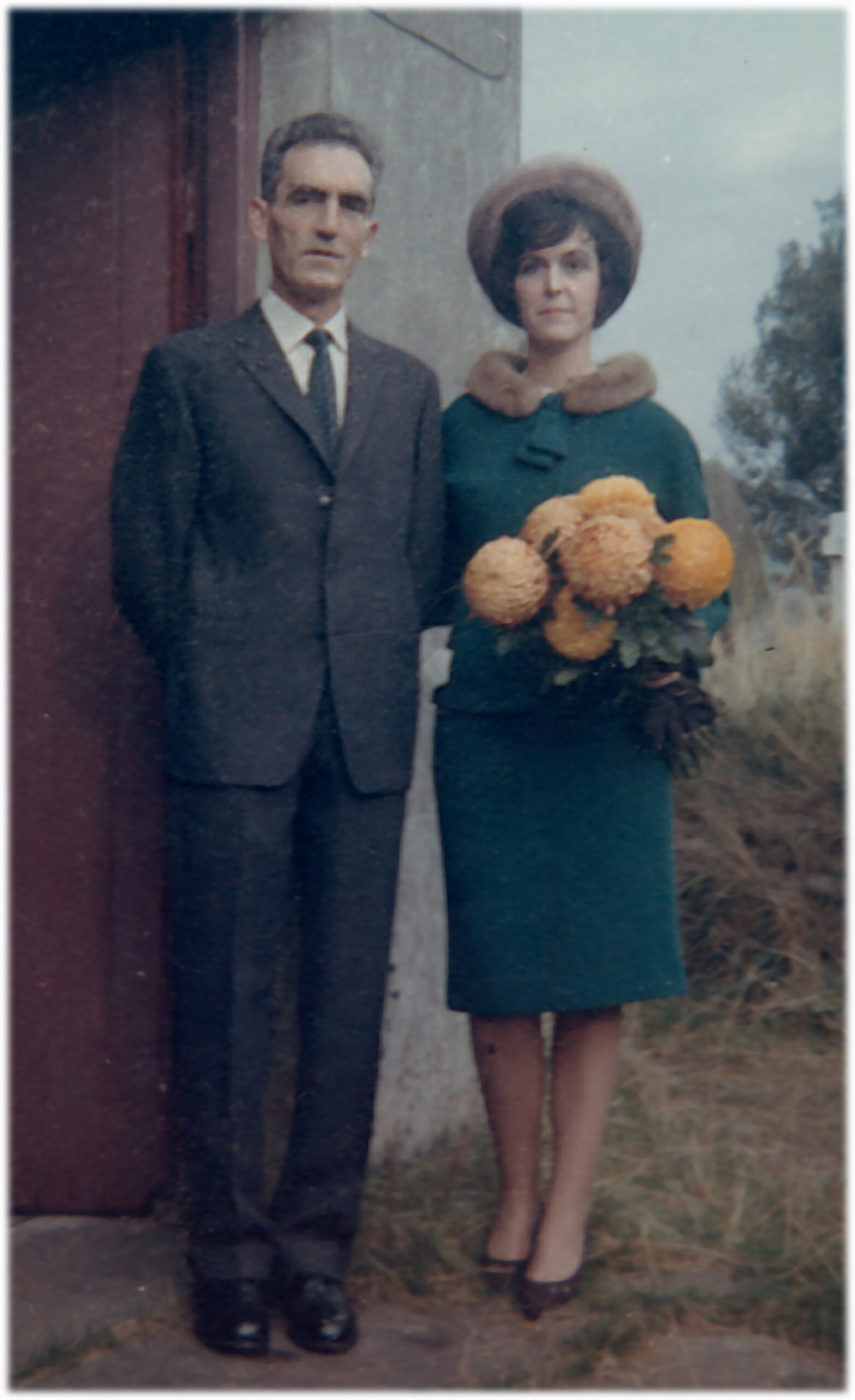
Also in 1966 there was a happy occasion with the marriage of the Musical Director Mr Glyn Davies to Miss Anne Thomas who was a member of the chorus. They were Married at the Melincwrt Chapel and the Society presented a monetary gift to them with which they purchased a wall clock, which is still owned by the Family.
~
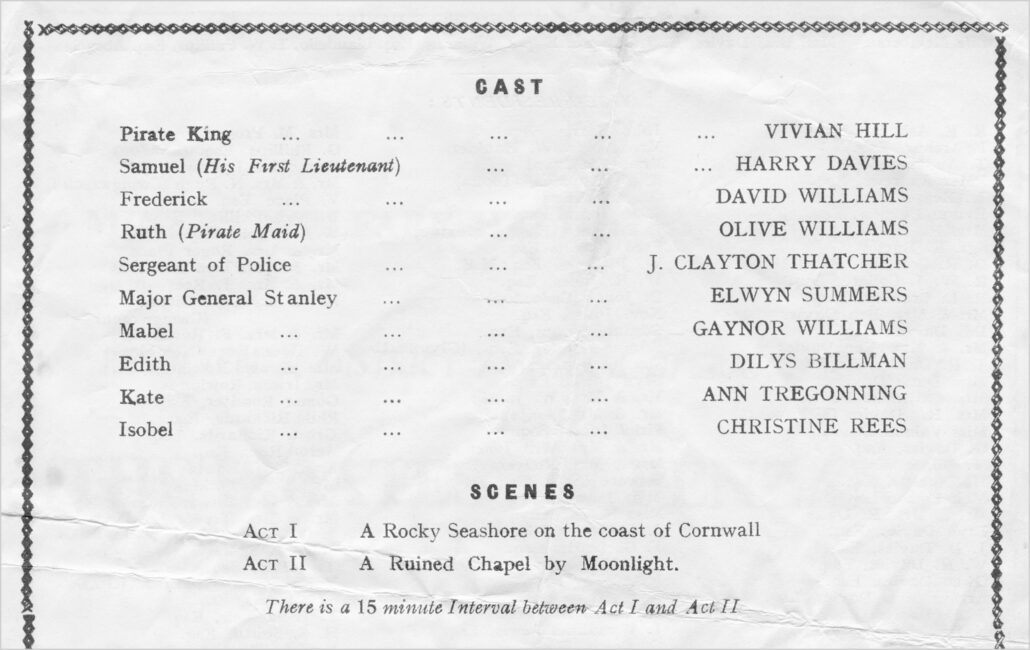
The Pirates of Penzance was performed at the Miner’s Welfare Hall from the 2nd – 5th of November 1966 and was enjoyed and well received, especially the Major-General’s song ‘I Am the Very Model of a Modern Major-General’ which is one of the most famous known ‘patter’ songs in all of the Gilbert & Sullivan Comic Operas.

……………………………………………………………………..
This G and S Comic Opera in two Acts was premiered at the 5th Avenue Theatre in New York City on 31st December 1879. The Pirates of Penzance is the only Gilbert and Sullivan Opera to have its official premiere in the United States.
The London premiere was on 3rd April 1880 at the Opera Comique where it ran for 363 performances.
There have been a number of modernised productions, on Broadway, and on film. The latest adaptation on Broadway in 2025 was called ‘Pirates! The Penzance Musical’.
……………………………………………………………………..
~
Some information taken from ‘Resolven Operatic Society’ – ‘A History from 1925 ~ 1976’ by Nesta Hopkins with additional information from Owen & Christine Davies.
Compiled by Lorna & Hugh Lewis.
~ ~ ~ ~
/to be continued